

Thermoplastic Polyurethane Bike Tubes: B2B Sourcing & OEM Engineering Guide
Global buyer intelligence on modern TPU inner tube chemistry, rotational inertia reduction, puncture performance analytics, and OEM volume manufacturing engineered in Austria.

OEM & Wholesale Excellence
Elevate bike specs, reduce shipping volume by 70%, and optimize workshop margins with Austrian-engineered TPU inner tubes.
Why Global Buyers Are Transitioning Complete Bike Specs & Workshop Supplies to Thermoplastic Polyurethane (TPU) Inner Tubes
For over a century, the global bicycle industry relied heavily on vulcanized synthetic butyl rubber and natural latex as standard inner tube materials. However, as international bicycle original equipment manufacturers (OEMs), brand managers, large-scale distributors, and fleet operators face shifting consumer demand toward lightweight performance, extended range in e-mobility, and reduced supply chain carbon footprints, traditional tube materials present fundamental technical limitations. Thermoplastic Polyurethane (TPU)—a high-performance elastomer engineered through precise block copolymerization—delivers unprecedented tensile strength, puncture energy absorption, and thermal resilience while cutting material weight by up to 75% compared to standard butyl.
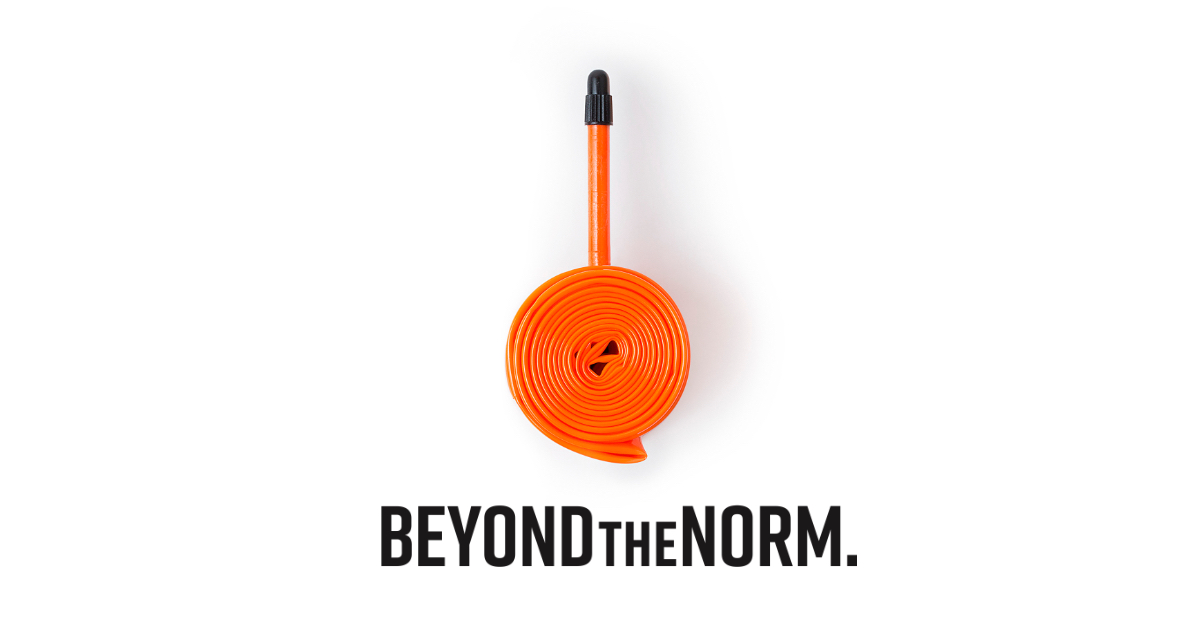 Vulcanized Butyl Austrian TPU Chemistry
 The Engineering Shift: How TPU Redefines Tire Dynamics
At a molecular level, thermoplastic polyurethane combines hard crystalline segments that provide mechanical strength and abrasion resistance with soft amorphous segments that give extreme elasticity. In contrast to heavy vulcanized rubber which experiences permanent deformation and degradation over time, TPU elastomers can be processed with wall thicknesses as low as 0.15 mm while maintaining superior structural integrity.
-

Rotational Inertia Optimization
Saving weight at the outermost radius of the wheel yields double the energy savings compared to static frame weight during acceleration and climbing. A 75% weight reduction per wheel radically elevates ride responsiveness for road, gravel, and mountain bikes.
-

Superior Tear & Pinch Resistance
TPU demonstrates higher elongation-at-break metrics and energy-to-puncture thresholds under DIN ISO testing. The material stretches around sharp object intrusions rather than immediately tearing, dramatically decreasing roadside flats and snakebites.
-

Supply Chain & Freight Efficiency
Because TPU tubes fold down to a fraction of the volume of butyl, distributors and OEMs can pack 3 to 4 times more units per master carton, drastically dropping international sea/air freight costs per unit and maximizing warehouse shelf productivity.
| Performance Metric | Standard Butyl Tube | Natural Latex Tube | Tubolito TPU Tube (S-TUBO / TUBO) |
|---|---|---|---|
| Average Weight (700x25c Road) | 100–120 g | 75–85 g | 23–38 g (Up to 75% Lighter) |
| Wall Thickness Uniformity | 0.80–0.90 mm | 0.50–0.60 mm | 0.15–0.30 mm High-Precision Extrusion |
| Needle Puncture Resistance (N) | Baseline (1.0x) | 1.2x Baseline | 2.0x to 4.0x Baseline (X-TUBO Series) |
| Air Retention Half-Life | High (Inflate monthly) | Very Low (Inflate daily) | High / Comparable to Premium Butyl |
| Packed Storage Volume | 100% (Baseline standard) | 85% of Butyl | 25% of Butyl (Pocket Size) |
| Recyclability & Eco-Footprint | Non-recyclable vulcanized scrap | Biodegradable but chemically treated | 100% Thermoplastic Recyclable Material |
Source: Internal Austrian laboratory testing conducted under standardized ISO 527 tensile and ISO 6603 puncture dynamics protocols.
Category-Specific Thermoplastic Polyurethane Solutions
Every cycling discipline imposes unique structural demands regarding inflation pressure, tire volume, impact forces, and heat dispersion. Tubolito's engineering team customizes TPU film formulations, wall thicknesses, and valve-junction reinforcements for every market segment.








Pioneering Breakthroughs in TPU Manufacturing
Standard TPU manufacturing often suffers from weak seam points or valve stem detachment under high temperatures. Tubolito solves these manufacturing bottlenecks through proprietary seam-welding technology and integrated micro-electronics.

X-TUBO Technology
Engineered with a reinforced multi-layer TPU matrix, the X-TUBO line passes severe puncture tests that penetrate conventional butyl tubes with ease. Specially designed for urban commuting, long-distance touring, and commercial e-cargo fleets where downtime equals financial loss.
Inquire Now
TUBO-PSENS Smart Sensing
The world’s first smart TPU inner tube with an embedded, battery-free Near Field Communication (NFC) chip. Cyclists and fleet managers can instantly read exact tire pressure down to 0.1 BAR precision simply by tapping a smartphone near the wheel, eliminating pressure gauge inaccuracies.
Inquire NowComprehensive Model & OEM Specification Guide
Review engineering tolerances, weight baselines, valve stem specs, and rim compatibility for broad procurement planning.
| Model Series | Target Application | Unit Weight | Tire Width Compatibility | Valve Options | Brake System Approval |
|---|---|---|---|---|---|
| S-TUBO Road | Ultralight Competition Road | 23–25 g | 700x18c to 700x30c | Presta 42/60/80 mm | Disc Brake Only |
| Tubo-Road | Performance Road / Training | 38–40 g | 700x18c to 700x30c | Presta 42/60/80 mm | Disc & Rim Brake Approved |
| S-TUBO CX/Gravel | Ultralight Gravel / CX Race | 35–36 g | 700x30c to 700x50c | Presta 42/60 mm | Disc Brake Only |
| Tubo-CX/Gravel | All-Road / Adventure Gravel | 54–55 g | 700x30c to 700x50c | Presta 42/60 mm | Disc & Rim Brake Approved |
| S-TUBO MTB | XC Racing / Marathon MTB | 42–43 g | 26" / 27.5" / 29" x 1.8"–2.5" | Presta 42 mm | Disc Brake Only |
| Tubo-MTB | Trail / Enduro Mountain Bike | 78–84 g | 26" / 27.5" / 29" x 1.8"–2.5" | Presta 42 mm | Disc Brake Approved |
| Tubo-MTB PSENS | Smart Pressure Sensing MTB | 92 g | 27.5" / 29" x 1.8"–2.5" | Presta 42 mm (NFC Embedded) | Disc Brake Approved |
| Tubo-MTB Plus | E-MTB / Plus Tires | 101 g | 27.5" / 29" x 2.5"–3.0" | Presta 42 mm | Disc Brake Approved |
| Tubo-BMX | Street / Park / Race BMX | 58–78 g | 20" x 1.5"–2.5" | Presta / Schrader Auto Valve | Rim & Disc Approved |
| X-TUBO City/Tour | Commuter / Heavy Touring | 176–182 g | 700x30c to 700x50c | Presta / Schrader Auto Valve | Rim & Disc Approved |
| Tubo-Folding | Compact Folding (Brompton) | 34–43 g | 16" / 20" x 1-1/8"–1-3/8" | Presta / Schrader Auto Valve | Rim & Disc Approved |
| Tubo-Cargo | Urban Utility & E-Cargo Fleets | 83–121 g | 20" / 24" / 26" x 1.75"–2.5" | Presta / Schrader Auto Valve | Disc Brake Approved |
Global Procurement & Market Evolution of TPU Inner Tubes
Detailed analysis for commercial procurement directors, bike brand specifiers, and global cycling distributors.
1. Global Procurement Trends: The Strategic Shift in Complete Bike Integration
The global bicycle component market is undergoing a rapid transition toward high-efficiency materials. Commercial procurement data indicates three main drivers shifting purchasing behavior from butyl to high-grade TPU inner tubes:
- OEM Spec Differentiation: Premium bicycle manufacturers (spanning road racing, gravel adventure, and lightweight e-bikes) are increasingly replacing standard butyl tubes with TPU as original equipment. Specifying TPU inner tubes allows brands to advertise immediate bike weight reductions of 150g to 300g per bike off the showroom floor at a fraction of the cost of carbon wheel or component upgrades.
- Logistics Cost Mitigation: High ocean freight rates and warehouse storage fees have forced global distributors to optimize freight density. Because Tubolito TPU tubes require 75% less physical volume than butyl rubber, a standard 40-foot container can house nearly 4 times the unit volume of TPU tubes, drastically reducing landed cost per unit.
- Retail Margin & Workshop Productivity: Independent bicycle dealers (IBDs) and online retailers benefit from higher retail price points and stronger unit margins. Additionally, workshop mechanics report faster installation times and cleaner tire seating compared to sticky butyl tubes.
2. Technological & Material Evolution Trends of TPU in Cycling
Thermoplastic polyurethane technology continues to evolve rapidly beyond simple material substitution. Key engineering trajectories shaping the next decade include:
- Advanced Monomaterial Ultrasonic Seam Welding: Early iterations of TPU tubes suffered from inconsistent heat sealing at the longitudinal joint. Next-generation Austrian extrusion and automated ultrasonic welding ensure a seamless molecular bond, eliminating air loss at joint points.
- Thermoplastic Valve Stem Integration: Legacy TPU tubes relied on aluminum or brass valve inserts bonded with adhesive. Modern Tubolito engineering utilizes customized TPU valve stems thermomechanically fused directly to the tube body. This prevents thermal detachment and eliminates galvanic corrosion.
- Smart Sensor & IoT Integration: As smart cycling ecosystems expand, integration of passive RFID and NFC sensor chips directly into the TPU membrane allows real-time pressure monitoring without adding rotating weight or balance offsets.
- Circular Recycling & Eco-Compliance: Unlike vulcanized butyl rubber, which cannot be melted down and re-molded, 100% thermoplastic polyurethane can be re-pelletized into new industrial TPU products. Global bicycle brands leverage this capability to satisfy strict European Union ESG mandates and extended producer responsibility (EPR) regulations.
100% Traceability & Strict Quality Assurance Protocols
To ensure flawless performance under demanding commercial conditions, Tubolito enforces a zero-defect quality control protocol. Every single thermoplastic polyurethane bike tube produced in our facility undergoes pressure retention testing prior to final packaging.
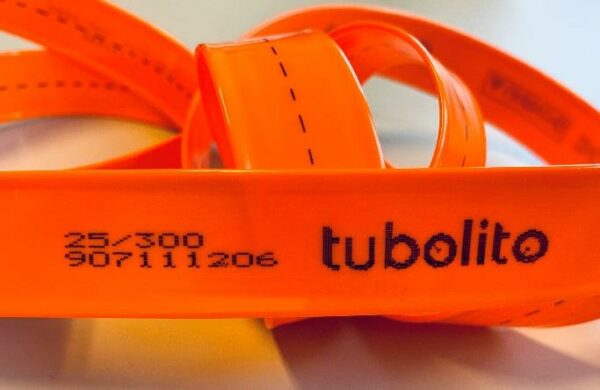
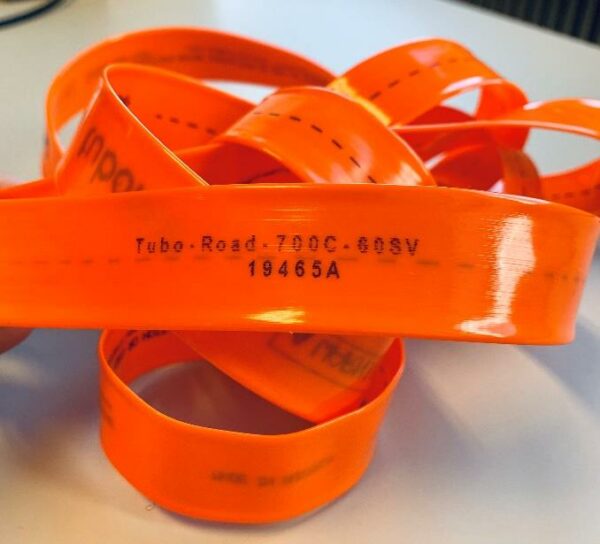
- 9-Digit Product Code: Laser-engraved directly adjacent to the brand logo for immediate identification of production batch dimensions and component specifications.
- 5-Character Batch Identification: Enables comprehensive reverse-traceability back to the raw thermoplastic polymer resin lot, extrusion machine parameters, and operator logs.
- Industrial Pressure Hold Testing: Every tube is inflated and monitored for 24 hours in a controlled environment to verify zero air loss before receiving final clearance.
Partner with the Pioneer in Thermoplastic Polyurethane Tubes
Whether you are designing a flagship carbon road bike, outfitting an e-cargo delivery fleet, or expanding your regional distribution network, Tubolito provides complete B2B engineering support, custom valve configurations, and tiered volume pricing.
Custom OEM Packaging
Bulk workshop packaging or retail-ready display boxes tailored to your brand standards.
Flexible Order Quantities
Scalable MOQs structured for independent distributors and global assembly lines.
Rapid Global Logistics
Direct shipment from our central European logistics hubs to ports worldwide.
Dedicated Technical Support
Direct access to our Austrian polymer engineers for rim and tire fitment validation.
Start Your B2B Sourcing Inquiry
Connect with our corporate supply team to request sample kits, technical spec sheets, and wholesale pricing tiers.
Inquire Now